 Pino
Pino
Pino's Solana mint distinguishes its token from assets using the same name
Pino purchases depend on selecting its Solana mint, the address identifying the asset intended as the swap's output token. Another asset can display the same name, PINO symbol, or dinosaur artwork while using a different mint. Matching those labels does not establish a token match. The decisive comparison is between the intended mint and the selected output token's full address. That comparison belongs before authorization, when a wrong selection can still be corrected. A successful swap records the mint of the tokens credited to the receiving account. Token identity also differs from trading conditions: the correct asset can still have an unattractive quote or no supported swap route.
Resolve a duplicate PINO search result before signing
For a wallet-based PINO selection, the output token's full address must match 7b36cKRYFZsMp3vLByVwfVQxW2ndcYth5rhPnyypump on Solana mainnet. In this illustrative selection, that match allows quote review. A duplicate-named result with a different mint requires changing the selected asset before authorization.
- Continue to quote review when the full output mint matches the intended token on Solana.
- Leave a mismatched selection unsigned, and search for the intended mint where address lookup is available.
- If that mint has no usable swap route, stop there; a similarly named token cannot substitute for it.
- After submission, look for a successful finalized swap and the intended mint in the receiving wallet's token-account records.
A returned transaction signature alone does not prove completion. For an existing receiving account whose owner stays the same, its balances before and after the swap transaction show the net change in its holding. A newly created receiving account appears only with its post-transaction balance. These records connect the selected mint to the actual holding, even if the wallet displays an ambiguous name.
Name searches and address searches serve different purposes
A name search can locate a recognizable candidate among several results, while a full-mint search, when the interface supports it, ties the lookup to the exact address supplied without relying on a unique display name. Address lookup removes that ambiguity only when the address being searched is the intended one.
A result found by name
A name or symbol search can return a useful candidate without resolving its identity. The result's position, artwork, and displayed token count do not replace its mint. If the listing abbreviates the address, its expanded details need to expose enough information for a full comparison.
A result found by address
Searching by the full mint ties the lookup to a specific Solana token. It does not promise the interface supports trading that token. An absent quote can reflect routing or interface support, so substituting another result with the same symbol changes the intended purchase.
Saving the full mint preserves the identifier for later comparisons. A saved screenshot of a shortened listing preserves only the characters it displays.
Can another token use the PINO name and logo?
Yes. Different Solana tokens can use the same name and symbol. Artwork can also look identical across unrelated listings. Those similarities concern display information, while each mint retains its separate token identity. A copied label does not combine supplies or give its holders units of the original asset.
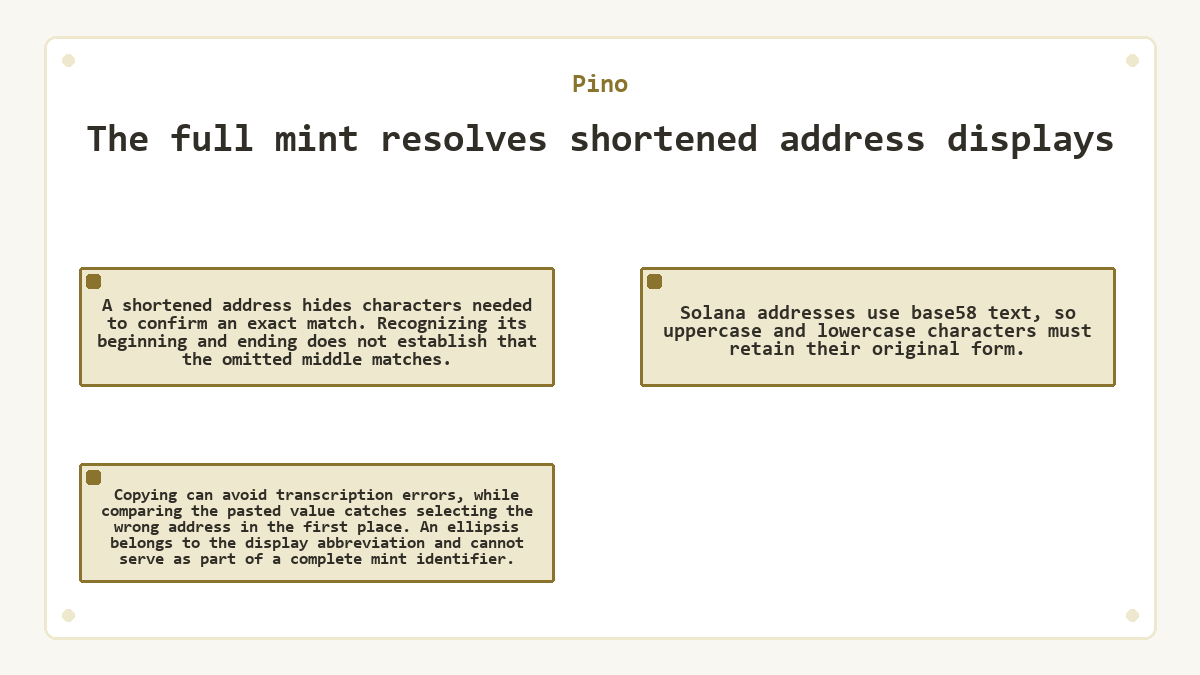
The full mint resolves shortened address displays
A shortened address hides characters needed to confirm an exact match. Recognizing its beginning and ending does not establish that the omitted middle matches. Solana addresses use base58 text, so uppercase and lowercase characters must retain their original form. Copying can avoid transcription errors, while comparing the pasted value catches selecting the wrong address in the first place. An ellipsis belongs to the display abbreviation and cannot serve as part of a complete mint identifier.

Mint accounts, holdings, and pools identify different objects
A Solana trade can involve several addresses because the token, the account holding it, and the trading pool are separate objects. Each address answers a different question. Reading an address without identifying its role can confuse the asset being selected with the infrastructure handling it.
The mint identifies the asset
The mint account stores shared token information, including supply and decimal precision. It does not record a particular holder's balance. A token lookup concerns this account's address; copying an address from an unrelated field can select another object even when the surrounding screen prominently displays PINO.
The token account records a holding
A token account records units of a particular mint and identifies the authority controlling that holding. Its address differs from the mint it references. The standard associated token account derives its address from the wallet, token program, and mint, so its address also differs between holders of the same token.
The pool address identifies a market
A decentralized pool has its own address and identifies the token mints it trades. Different pools can involve the same asset. A pool ID describes a trading venue within that market; it cannot replace a mint in a field requesting the token identifier.
The output asset and quoted amount answer separate questions
The output mint identifies the asset being bought, and the quote describes an amount under the selected trading conditions. A large-looking output count cannot establish that the intended token was selected. Where a swap enforces a minimum-output condition, the limit concerns units of the chosen mint. The swap fails if execution would return fewer units. Loosening the price constraint cannot correct an asset mismatch.
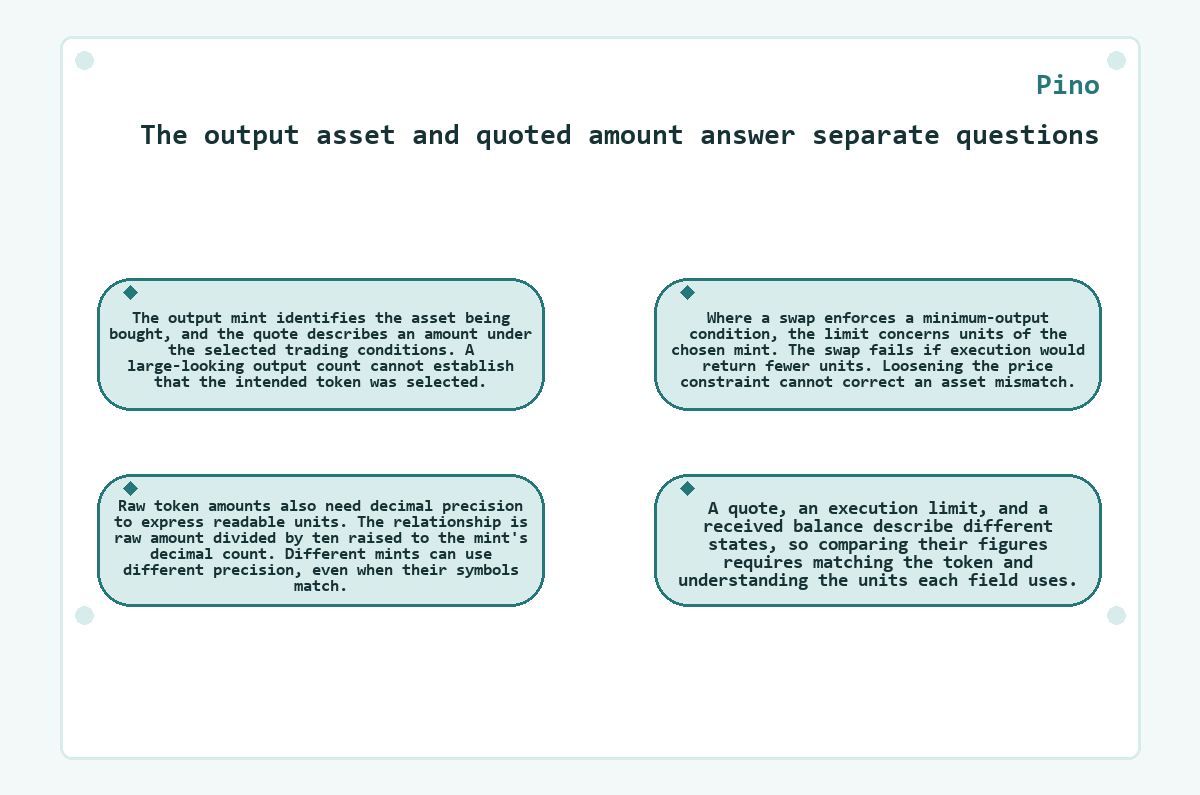
Raw token amounts also need decimal precision to express readable units. The relationship is raw amount divided by ten raised to the mint's decimal count. Different mints can use different precision, even when their symbols match. A quote, an execution limit, and a received balance describe different states, so comparing their figures requires matching the token and understanding the units each field uses.
A matching mint leaves liquidity and price risk unresolved
Matching the mint resolves identity without promising a favorable trade or later resale. Available liquidity and the input amount affect the executable quote. A genuine token can still fall in value, and a successful purchase does not promise a future buyer at the same price. These considerations belong after the asset match because a quote for another mint describes another purchase. A lack of routing support changes the available trading path, not the identity of the intended token.
Branding edits and replacement mints have different effects
A token can receive updated branding without changing its mint when its metadata settings permit the update. A replacement mint defines a separate asset, even when the naming remains familiar.
Edits to existing metadata
For mutable Metaplex metadata, an authorized update authority can edit the token's name or symbol. Updating mutable Metaplex token metadata leaves the mint address unchanged. Existing units retain their identity, even if a wallet later displays revised wording or artwork. The token's actual metadata permissions determine whether those edits are available.
Metadata permissions differ from the authority to create additional token units. Permission to edit branding does not establish control over supply.
A replacement token with another mint
A move to another mint needs a separately specified distribution or conversion mechanism. A changed website, social profile, or logo alone does not establish a token conversion. Old units and replacement units reference different mint accounts, so their shared branding cannot make their balances interchangeable. The expected mint changes when the intended purchase changes to that distinct asset.
Intermediate route assets differ from the final output token
A routed swap can involve intermediate token mints while still ending in the intended PINO mint. Those intermediate assets describe parts of the trading path. Where an interface exposes route details, each leg has its own input and output, and an intermediate leg's output need not be the final asset credited to the receiving wallet after successful execution. Pool-level charts describe trades in their particular pools.
The overall output mint identifies the asset the complete swap targets. Seeing another mint somewhere inside a route therefore requires interpreting its role. If the final output mint changes, the transaction targets another asset.
Questions people ask about Pino
What does CA mean beside a PINO address?
CA usually abbreviates contract address in token listings. For this Solana token, the relevant asset identifier is its mint address. The label does not make every address nearby interchangeable: a pool, token account, or shared token program can have its own address.
Is the token program address the same as the PINO mint?
The token program address identifies shared software, while the PINO mint identifies a particular asset. Many unrelated tokens use the same token program. A matching program ID therefore establishes which program handles token operations, without establishing that two listings represent the same token.
Must I connect a wallet to read the PINO mint record?
Reading a public mint record does not require connecting a wallet or signing a transaction. Its public account information identifies the token and exposes relevant on-chain fields. A request for a recovery phrase or private key has no role in reading that record.
Are PINO balances in different token accounts different assets?
Balances in different token accounts represent the same asset when those accounts reference the same mint. Their account addresses can differ because they record separate holdings. Combining them into one wallet total also requires matching the controlling owner, so another holder's balance does not belong in your total.
How can I tell whether an exchange accepts the same PINO token?
The exchange's supported network and token mint must match the asset you hold. A PINO trading symbol alone does not establish deposit compatibility. Deposit availability can also differ from trading availability, so a market listing does not by itself establish that the exchange can credit an incoming transfer.
Does a PINO balance increase prove a purchase occurred?
A balance increase alone does not prove a purchase occurred. An incoming transfer can increase holdings of the same mint without a swap. The transaction's instructions and corresponding input changes explain the operation; the receiving account's mint identifies the asset credited.
How is a PINO mint different from a transaction signature?
A mint identifies a token, while a transaction signature identifies a particular signed transaction. Many trades can reference the same mint. The signature distinguishes those transactions; a successful finalized status establishes completion. The mint alone carries no transaction status.