 Pino
Pino
Pino liquidity supports pool swaps whose proceeds depend on trade size and available depth
Pino liquidity enables pool-backed swaps, while the available reserves and size of a PINO sale determine its quoted proceeds. A pool's displayed value estimates the combined worth of its reserves; a sell quote estimates the asset amount returned for a specific input. Even a substantial pool value can accompany a poor rate for a large sale, especially when usable depth is limited. For this Solana token, a useful liquidity assessment connects the selected mint, sale amount, output asset, and quote conditions. The output for that trade matters alongside its applicable fees and minimum-output limit.
Jump to a section
The short version: For an exact-input PINO sale, wider slippage tolerance allows a lower minimum output without increasing the pool's available reserves.
The paired reserve supplies the asset a PINO sale returns
In a two-asset pool, PINO and its paired asset supply opposite sides of a direct swap. Selling into that pool increases its PINO reserve and draws proceeds from the paired reserve. The pool's pricing rule links those changing balances to the exchange rate. A reserve containing many PINO tokens therefore does not establish how much of the other asset a sale can return.
A displayed total value can include both assets, whereas direct sale proceeds come from the output side. The units matter: a combined currency valuation differs from the number of output tokens available. When a supported route chains several pools, each leg has its own reserves and charges. A shallow intermediate pool can constrain the final output even when the PINO pool itself has more depth.
Which PINO quote reflects the sale you intend to make?
An exact-input quote for the intended PINO quantity and chosen output asset estimates that sale's proceeds under the quoted market conditions. Raw output amounts are directly comparable when quotes use the same PINO input and receiving asset under contemporaneous market conditions. Otherwise, a larger output number may reflect different units or a different sale size.
Available choices can include a direct pool swap or a supported route through intermediate assets. A router may also split an input across pools where its routing engine supports that choice. Each pool contributes pricing and charges, so the final output after included fees governs the comparison. Any separately charged transaction costs also affect the total cost of the sale.
Changing the amount or receiving asset requires a new calculation.
Sale size changes the average rate in a constant-product pool
With unchanged starting reserves, a larger sale into a constant-product pool receives fewer units of the paired asset per PINO. Ignoring fees and rounding, a constant-product swap preserves the product of its two token reserves. Each additional unit sold encounters a changed reserve ratio.

Let x represent the starting PINO reserve, y the paired reserve, and a the PINO input. Before fees and rounding, the output follows output = y * a / (x + a). The denominator grows with the sale amount. Doubling the input therefore yields less than double the output from the same starting reserves.
The average rate equals output divided by PINO sold. A spot price describes the rate before the sale changes reserves.
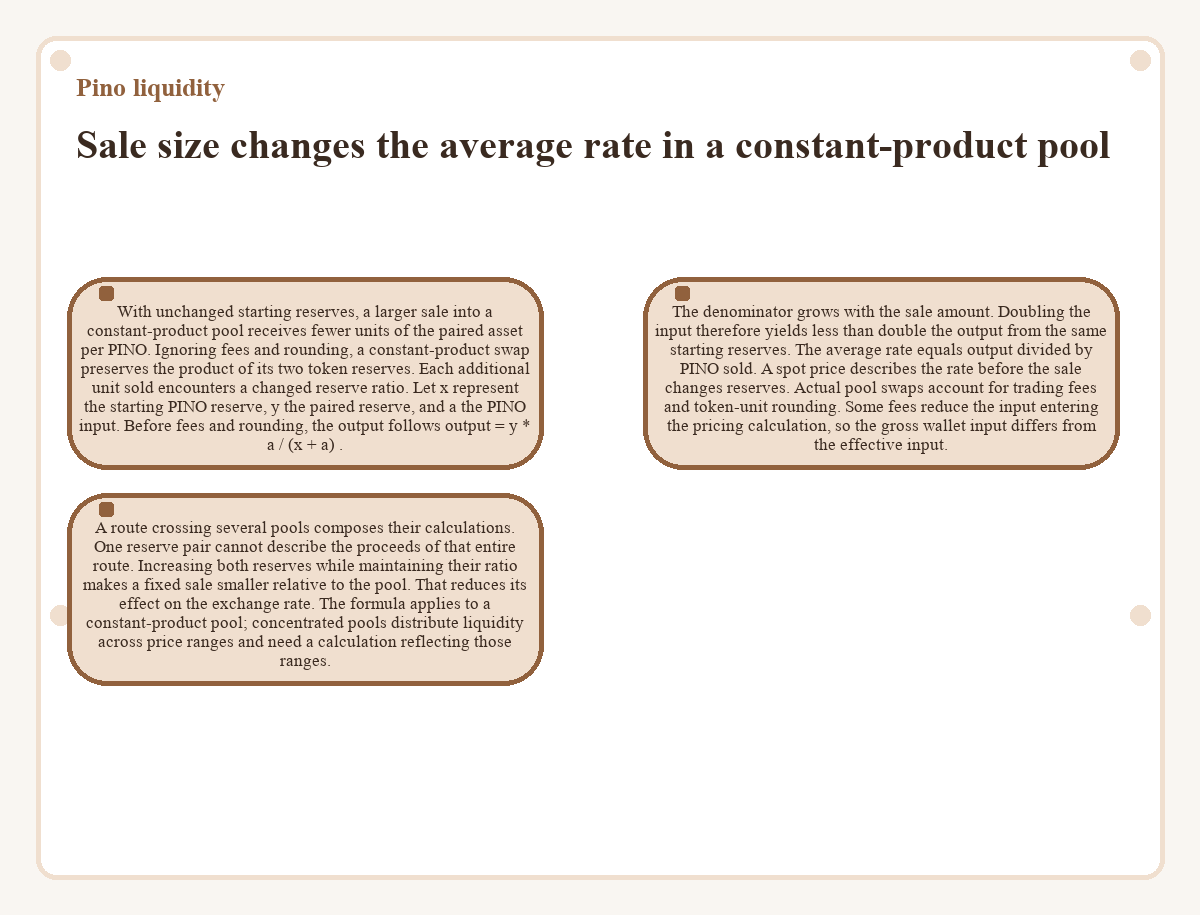
Actual pool swaps account for trading fees and token-unit rounding. Some fees reduce the input entering the pricing calculation, so the gross wallet input differs from the effective input. A route crossing several pools composes their calculations. One reserve pair cannot describe the proceeds of that entire route.
Increasing both reserves while maintaining their ratio makes a fixed sale smaller relative to the pool. That reduces its effect on the exchange rate. The formula applies to a constant-product pool; concentrated pools distribute liquidity across price ranges and need a calculation reflecting those ranges.
Price impact enters the quote before slippage occurs
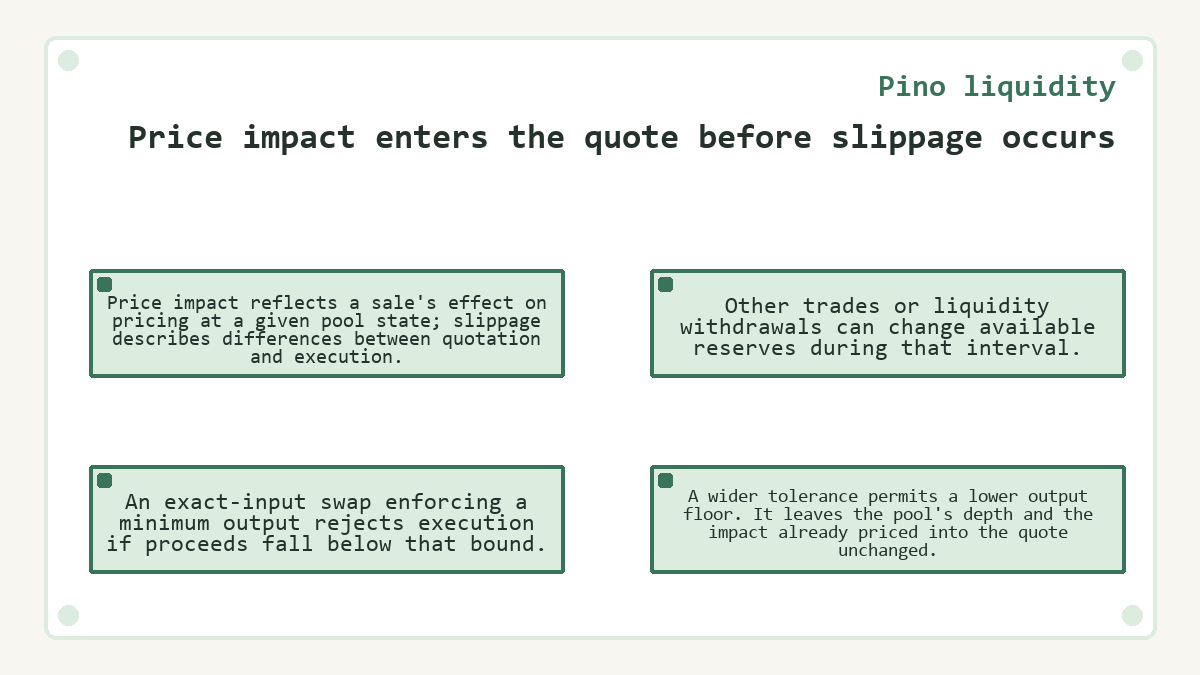
Price impact reflects a sale's effect on pricing at a given pool state; slippage describes differences between quotation and execution. Other trades or liquidity withdrawals can change available reserves during that interval. An exact-input swap enforcing a minimum output rejects execution if proceeds fall below that bound. A wider tolerance permits a lower output floor. It leaves the pool's depth and the impact already priced into the quote unchanged.
Total pool value can overstate depth at the trading price
Reported pool value can change because asset prices change, even when nobody adds liquidity and token quantities stay constant. A larger valuation alone therefore does not prove more trading capacity. The quantities on each side, the pricing model, and the size of the proposed trade determine what the pool can return.
Concentrated pools place capital inside chosen price bands. A concentrated-liquidity position supplies swap liquidity only while the pool price lies within its selected range. Trading can move into a band with less active liquidity. A total across all positions includes capital located away from the immediate trading price, so substantial pool value can coexist with little nearby depth.
An aggregate across several PINO pools also differs from the liquidity a particular route can access. An interface may support only some markets, and each supported route has its own constraints. Capital elsewhere does not automatically contribute to the selected quote. Adding liquidity improves usable depth only when that capital becomes available along the relevant pricing path.
Does a liquidity lock guarantee a PINO sale at the displayed price?
A liquidity lock does not guarantee a PINO sale at the displayed price. It restricts withdrawal of the covered liquidity position under the lock's terms. Swaps can still change reserve balances, and sellers still encounter the pool's pricing curve. The affected pool, locked share, and any release conditions define the protection. A statement about one position does not establish a lock across every PINO market. Sale proceeds continue to depend on the executable quote and market state.
A missing route stops the sale before authorization
A supported route to the chosen output asset is a prerequisite for a pool-backed PINO sell quote. For an illustrative sale, assume the selected token already matches the intended mint. An available route provides a quote for the entered amount, which you can check against these conditions:
- The input is the intended PINO token, and the final output is the asset the sale should return.
- The quote covers the full intended PINO input, rather than only a smaller test amount.
- The quoted output reflects the selected amount and the liquidity the route can use.
- The fee details distinguish charges included in output from costs charged separately.
- The minimum output remains acceptable if execution reaches the permitted limit.
If the interface returns no route, it has found no executable trading path for that request. Increasing slippage tolerance does not supply one. If a routing restriction excludes usable pools, allowing those supported pools can expose a path if one exists. Request a fresh quote after changing that restriction.
Stop before signing if the complete input still has no usable route or the resulting minimum output is unacceptable. Changes in reserves or routing support can alter availability later; a past quote does not establish a usable route now.
Helpful answers
-
Will dividing a PINO sale into smaller swaps remove price impact?
- Smaller swaps do not reset the reserves each preceding sale has changed. Ignoring fees and rounding, splitting a sale follows the same constant-product pricing curve if no other trades or liquidity changes intervene. Changed market conditions or access to different liquidity can improve quotes; fee treatment and rounding also affect actual proceeds. Separate transactions also incur separate network charges, which can offset a better quoted rate.
-
Does a low PINO token tax make a swap free?
- A low or absent token tax does not eliminate pool trading fees or network charges. An interface may also charge a platform fee. The relevant total comes from the selected route's fee treatment and transaction costs, including which deductions the quoted output already incorporates.
-
How does adding PINO liquidity change exposure compared with holding the tokens?
- Providing liquidity creates exposure to the pool's changing asset composition. As swaps exchange PINO against the paired asset, a provider's share can contain different quantities than the original deposit. Relative price changes can make the position worth less than holding the deposited assets separately, a difference called impermanent loss. Trading fees can offset some of that difference without guaranteeing a net gain.
-
Are wallet-held PINO tokens part of a pool's liquidity?
- Ordinary PINO holdings in a wallet are separate from reserves available to a liquidity pool. Holder counts and aggregate wallet balances therefore do not measure trading depth. A supported liquidity deposit makes assets available under the pool's rules. Merely owning tokens does not make them accessible to a router for someone else's swap.
-
Must a PINO sale return a stablecoin?
- A PINO swap can return another supported cryptocurrency when a usable route to that asset exists. The output choice depends on the interface and available liquidity, rather than a universal stablecoin requirement. Receiving a cryptocurrency also leaves exposure to that asset's price. A token swap does not itself convert the proceeds into a bank balance.
-
What explains different PINO liquidity totals on different dashboards?
- Liquidity totals can differ because dashboards count different pools, apply different asset valuations, or update at different times. Some displays aggregate a token's markets; others describe one pool or distinguish active liquidity from total deposits. Comparing their definitions and timestamps explains whether they measure the same quantity. Neither total substitutes for a quote using the intended sale amount.
-
Is PINO market capitalization money available to sellers?
- Market capitalization is a valuation derived from token price and circulating supply, not a reserve of sale proceeds. It applies a unit market price across that supply without estimating the price impact of selling those tokens. Actual output depends on executable liquidity for the proposed transaction, so a large market capitalization alone cannot establish a sale's proceeds.
-
Could more trading volume leave a PINO pool with less exit depth?
- Higher trading volume can accompany a decline in the paired reserve available to PINO sellers. Volume measures completed trades over a period, while reserve balances describe the pool's state. Repeated sales can add PINO and remove the paired asset even as cumulative volume rises. The direction of those trades and any liquidity deposits or withdrawals determine the remaining depth.